
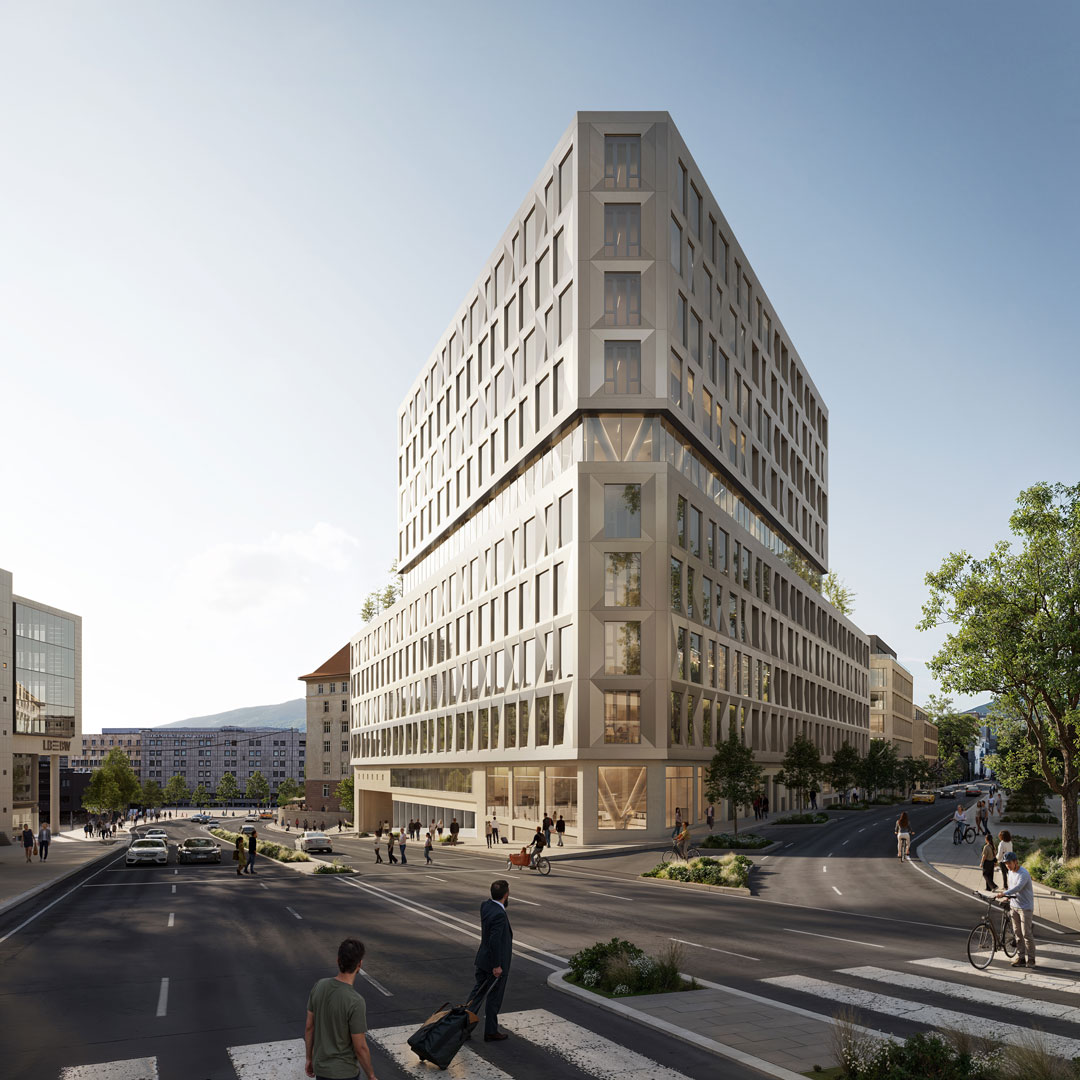
Weinbergquartier, Stuttgart
Wastewater Heat Pump Concept for Two Office and Commercial Buildings – Wastewater as a Renewable Source and Sink
How can a new inner-city development be supplied with heating and cooling in a cost-effective and sustainable manner? For two office and commercial buildings situated in the immediate vicinity of Stuttgart Central Station, we have examined various design options, including the use of the sewer system as both a heat source and a heat sink. The result: a supply concept whose total annual costs, despite higher initial investment, are significantly lower than those of a district heating solution.
Background: A new urban district at Stuttgart Central Station
A new urban quarter is being developed on a site of around 13,400 m² in the immediate vicinity of Stuttgart Central Station. The site includes the listed Alte Bahndirektion building, which is being refurbished. In addition, two new office and commercial buildings are being constructed.
MorgenGrün was commissioned to investigate different design options for the heating and cooling systems of the two new buildings. The assessment of the options covered both economic viability and the carbon footprint.
Comparison of options: District heating versus waste water heat recovery
The comparison contrasted a district heating scheme with a scheme using a wastewater/water heat pump. As a heat source, wastewater offers a dual benefit: as well as providing heating in winter, it also enables cooling via the sewer system. In summer, the wastewater acts as a heat sink, with surplus heat being discharged into the sewer. In this way, the administrative buildings can be cooled using renewable energy and with reduced electricity consumption.
Plant design concept for the preferred option
- Wastewater/water heat pump: using the sewer system as a heat source for heating and as a heat sink for cooling.
- High-temperature heat pump: supplying domestic hot water at the required temperature.
- Compression chiller: Absorbs waste heat from the IT rooms.
- Electric boilers: covering peak loads. Designing the heat pump to meet the base load reduces the capital costs of the overall system.
Practical application rather than theory: testing in the sewer
The feasibility of using waste water was part of the study. MorgenGrün was in contact with the energy supplier to discuss the installation of a heat exchanger in the sewer. A manufacturer designed the heat exchanger for the project and provided the necessary investment funds. Using measurement data supplied by the manufacturer, further assessments were carried out to determine the extent to which heating and cooling are actually possible via the wastewater heat exchanger.
Our experience shows that the focus is on feasibility, not just on theory.
Conclusion: Lower total annual costs despite a higher initial investment
Despite the higher capital costs of a heat pump system with a wastewater heat exchanger, the total annual costs are around 35 per cent lower than those of the district heating system. The high efficiency of the heat pump, which benefits from a largely constant wastewater temperature, reduces operating costs over the period under consideration. The wastewater heat pump therefore represents the more economical solution in the comparison of the options examined.
Images: © by bloomimages
Overview
Building Owner | Client
P + B Weinberg GmbH & Co. KG, Sankt Augustin
Architect
willwersch architekten . bda, Stuttgart
MorgenGrün Project Period
2024 to 2025
MorgenGrün Scope of Services
Energy concept
ZWP Scope of Services
Planning for sanitary systems, heating systems, cooling systems, ventilation and air-conditioning systems, electrical systems, IT and communications systems, lifts and conveyance systems, use-specific systems, building automation systems
Net Floor Area (NFA)
approx. 41,000 m²
CO2 Emissions Savings
150 t/a