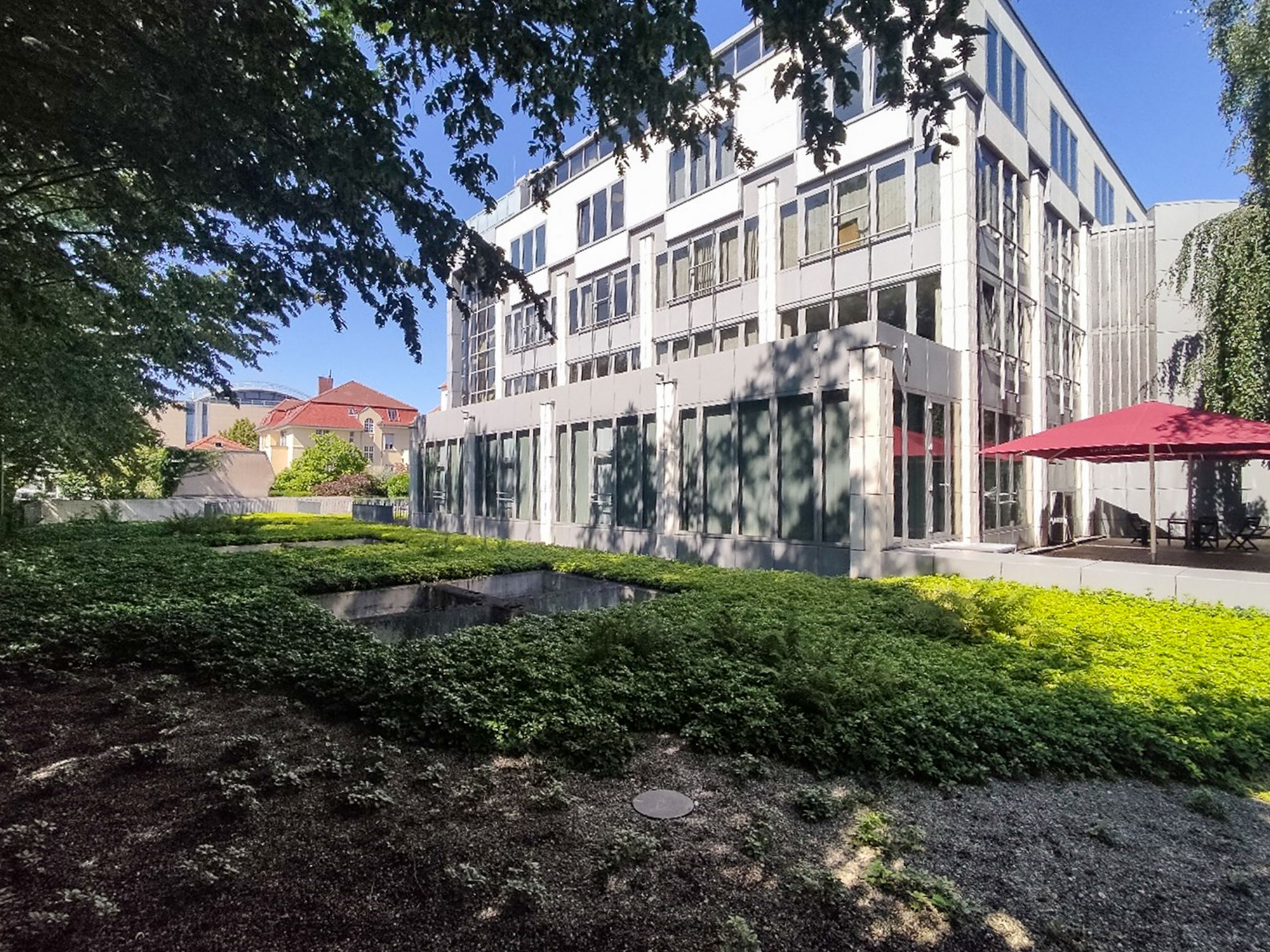
Renovation of the Thomas Dehler House, Bonn
Innovative Technology Meets Sustainable Vision – the Transformation of the Thomas Dehler House
The Thomas Dehler House in Bonn was already a pioneer in innovative building technology back in 1992. With a well-thought-out room conditioning concept, it offered maximum efficiency and comfort. Now, a holistic energy concept is making the building fit for the future. The modernisation significantly reduces energy consumption, optimises heating and cooling, and paves the way for climate-neutral operation by 2045. Through intelligent system integration and sustainable technologies, MorgenGrün is creating a forward-looking solution for existing buildings.
The building on Willy-Brandt-Allee in Bonn, now used by the International Renewable Energy Agency, was constructed in 1992 as the Thomas-Dehler-Haus for the federal headquarters of the Liberal Democratic Party (FDP). The technical building equipment was planned by the former Zibell Willner & Partner Ingenieurgesellschaft, now ZWP Ingenieur-AG.
From the outset, the focus was on the guiding principle of ‘invisible building services’: maximum efficiency and comfort through innovative surface cooling systems and source ventilation in the offices and meeting rooms. The clever ventilation concept with overflow into the atriums made it possible to dispense with an extensive exhaust air network.
Even the recooling of the refrigeration machines was integrated invisibly beneath the building – a concept that was ahead of its time.
Continuous modernisation – sustainability as a guiding principle
ZWP's expertise has been sought after on several occasions: in 2012, as part of a tenant change, to adapt the lighting systems, and six years later, during the renovation of the cooling systems and the outside air intake. The next significant step took place in 2023: the development of a comprehensive energy concept with the aim of achieving climate-neutral operation. The focus here was both on reducing energy requirements and on covering the remaining consumption in a particularly climate-friendly manner.
An in-depth study in 2024 identified a way to achieve the demanding ‘Efficiency Building Federal 55’ standard. This energy standard sets even higher requirements than the regular efficiency building standard.
Improved efficiency and resource conservation
Optimised ventilation systems: The heating requirements of the ventilation system are reduced by approximately 65% through the use of integrated recirculation systems.
Energy-efficiency upgrades to the building envelope: Insulation measures applied to structural elements between heated areas and the underground car park are particularly cost-effective, especially the insulation of walls and ceilings.
Energy-efficient recooling: Converting the recooling of the refrigeration process leads to significant electricity savings.
Photovoltaic potential analysis: All available roof and façade surfaces were assessed for their economic and environmental benefits.
Key issue: the transformation of heat generation
Converting the existing gas condensing boiler system to a sustainable energy supply presented a major challenge. Because the building’s radiators are designed for high flow temperatures of around 70 °C, conventional heat pump systems cannot efficiently meet the heating demand. To address this issue, the capillary tube ceilings – previously used exclusively for cooling – were also integrated for heating.
Thanks to the significantly increased heat transfer surfaces and the replacement of approximately 14% of the existing radiators, the building can be heated by a heat pump using flow temperatures of up to 50 °C. An electric peak-load boiler covers peak loads at very low outdoor temperatures and during the heating-up phase following weekend temperature reductions. It also enables completely combustion-free heat generation and – with intelligent control – does not lead to an increase in the office building’s peak electricity load.
From concept to eligible implementation
In conjunction with the subsequent HOAI-compliant specialist planning carried out by the ZWP branch in Bochum, MorgenGrün is responsible for energy-related specialist planning and construction supervision in accordance with BEG requirements (Bundesförderung für effiziente Gebäude = Federal Funding for Efficient Buildings). This includes assessing the existing building, verifying that the measures comply with funding criteria, and preparing the necessary supporting documentation for the application and payment. In addition, room-by-room heating load calculations, hydraulic balancing of the heating circuits, and optimisation of heat transfer will be carried out.
An acoustic emission assessment of the planned technical systems by our building physicists ensures that the forward-looking heating and cooling supply can be implemented in a compatible manner, even in a densely built-up environment.
Climate-neutral heating and cooling technology for the future
Despite the challenging site conditions – dense development and extensive underground structures – an efficient solution for renewable heating and cooling was found. Neither geothermal energy nor the use of waste heat from the nearby combined sewer proved feasible. Instead, a reversible air-to-water heat pump was identified as the optimal solution. Supplemented by an electric peak-load boiler, the building can be heated entirely without fossil fuels.
A flagship project for sustainable building services
After more than 30 years, the Thomas-Dehler-Haus is being made fit for the future. Through the continuous optimisation of building services and the gradual decarbonisation of the grid electricity mix, the building can be operated in a fully climate-neutral manner by 2045. The energy concept from MorgenGrün (formerly the ZWP Innovation Department) impressively demonstrates how visionary engineering and sustainable planning create future-proof solutions for the existing building stock.
Image: © MorgenGrün
Overview
Building Owner and Client
Reinhardtstraßenhöfe GmbH & Co. KG, Bonn
MorgenGrün Project Period
2023 to 2026
MorgenGrün Scope of Services
Study on sustainable heating, cooling and electricity supply, energy-related specialist planning and construction supervision
ZWP Scope of Services
Planning and site spuervision, heating systems, ventilation and air-conditioning systems, electrical systems, IT and communications systems, lifts and conveyance systems, lighting design, plans to modernise the cooling systems and the outdoor air intake
Gross Floor Area (GFA)
3,750 m² (plus 3,800 m² underground car park)
CO₂ Emissions Savings
CO2 savings from renovating the building envelope and implementing the energy concept to achieve the EG55 standard: 36 kg/m²a